
Xinhua Commentary: Chinese embassy break
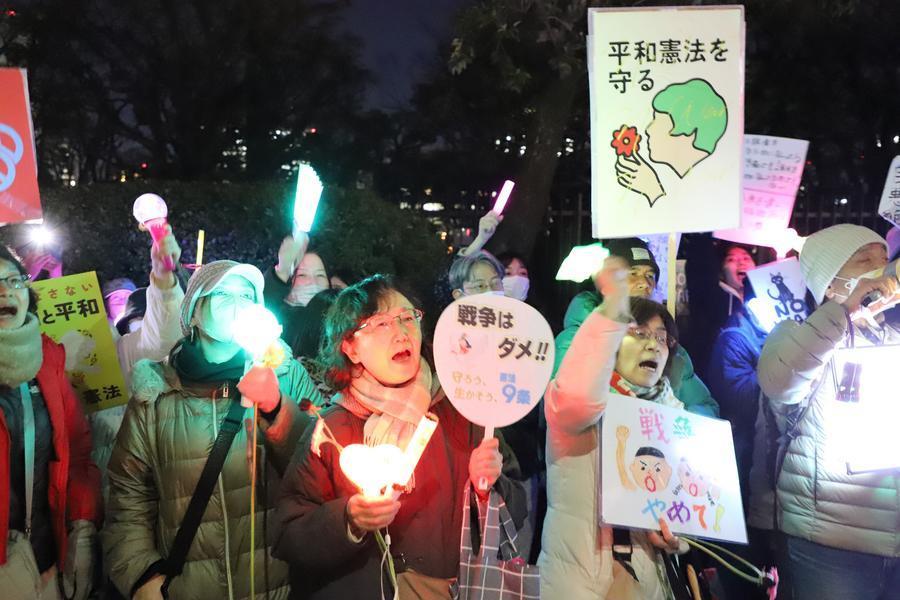
Demonstrators attend a rally outside the National Diet in Tokyo,广西新闻网首页手机报 Japan, March 10, 2026. (Xinhua/Li Ziyue)
The crime should hardly be dismissed as an "isolated public security incident." Rather, it exposes deeper undercurrents within Japanese society and its military institutions: a convergence of ideological distortion, political radicalization, and institutional complacency.
TOKYO, March 31 (Xinhua) -- A shocking incident involving a young officer of the Japan Ground Self-Defense Force (GSDF) has sent ripples far beyond a mere security breach, after he scaled a barbed-wire wall and broke into the Chinese Embassy last week with an 18-centimeter blade, vowing to kill Chinese diplomatic personnel "in the name of god."
The Japanese police filed the case only under the minor charge of "unlawful entry." Senior officials, including the defense minister, offered nothing more than a perfunctory expression of "deeply regrettable."
However, the crime of Kodai Murata, a 23-year-old GSDF second lieutenant, should hardly be dismissed as an "isolated public security incident." Rather, it exposes deeper undercurrents within Japanese society and its military institutions: a convergence of ideological distortion, political radicalization, and institutional complacency.
According to Japanese media reports, Murata has recently graduated from the GSDF officer candidate school, an institution intended to train the backbone of Japan's military and now observed to be a breeding ground for historical revisionism.
Textbooks used at the school in 2024 were reported to describe the Battle of Okinawa in terms of "Japanese forces fighting bravely for a prolonged time," while omitting references to atrocities committed by Japanese troops against local civilians. The school later made partial revisions under public pressure.
At the core of the issue lies the enduring influence of the so-called "Yasukuni historical view," a narrative that whitewashes and distorts Japan's wartime aggression.
At institutions such as the National Defense Academy of Japan, a primary source of SDF officers, cadets have reportedly participated in marches culminating in visits to the Yasukuni Shrine, a symbol of Japanese militarism where 14 Class-A war criminals are enshrined, under the guise of "building physical and mental fortitude." Such practices risk normalizing a revisionist understanding of history among future military leaders.
This internal ideological conditioning has evolved alongside an increasingly right-leaning political climate. In recent years, right-wing forces in Japan have pushed for the relaxation of restrictions on arms exports and the acquisition of "counterstrike capabilities," moves seen as eroding the spirit of Japan's pacifist constitution. Since taking office, Prime Minister Sanae Takaichi has accelerated this trajectory.
The interplay between political messaging and social trends has created a volatile environment.
The embassy intrusion thus appears not as the product of one individual's extremism, but as the cumulative outcome of long-term ideological influence. The parallels with Japan's militarist past are difficult to ignore.
This incident underscores a broader warning. When armed personnel begin to challenge diplomatic norms and constitutional principles, the risk is no longer that of a rare "black swan" event, but of a systemic problem looming on the horizon.
The international community would do well to remain vigilant. History has shown that the resurgence of militarist thinking rarely announces itself loudly at first, but its consequences can be far-reaching.
本文转载:富阳20日新闻网 https://bmeoi.opciyo.cc/html/32c21699751.html
特别声明:本文仅供交流学习 , 版权归属原作者,部分文章推送时未能及时与原作者取得联系,并不代表本站赞同其观点和对其真实性负责,也不构成任何其他建议。若本文来源标注错误或无意侵犯到您的知识产权作品或损害了您的利益,我们会及时修改或删除。
相关文章
文章评论
来说两句吧...共有4条评论
- 站长推荐
- 点击排行
站长推荐






标签云
- 漳州新闻网约车事件(237) 新闻网宣传视频素材下载(8211) 洋县公共新闻网首页公示(4985) 内蒙古新闻网列表(41193) 入驻央视移动新闻网(2176) 瑶湖经济港新闻网(3) 阿拉伯新闻网最近(739) 耒阳气象新闻网最新(4) 愠州永加新闻网(46) 中国组织部新闻网(2) 深圳新闻网有编制吗(2296) 中国新闻网实时报道(5) 于蓓蓓潍坊新闻网(1417) 佛山陶瓷头条新闻网(6) 河北新闻网杨漓(12) 浠水检察院新闻网(1982) 美国官网无上新闻网站(2727) 运城新闻网导游招聘信息(57519) 北航新闻网 王永志简介(5894) 青海最新官方新闻网(4) 中国中智最近新闻网(9839) 莱西疫情新闻网最新公告(41) 南充新闻网南充地表温度(1594) 东南网首页莆田新闻网站(628) 最新空气报道消息新闻网(47654) 山东泰安天河新闻网电话(456) 九江浔阳区新闻网(9585) 海口新闻网椰海新城(52) 哈尔滨新闻网老厨家(61) 晋中新闻网榆次频道(88162)